.png)

Two five-acre properties in Abbotsford can look similar in a listing and still offer very different possibilities.
One property might sit inside British Columbia's Agricultural Land Reserve, or ALR. Another may be outside the ALR. That distinction can affect questions about housing, subdivision, farming, soil and fill, and other land uses. But it is only the beginning of the investigation.
The most important thing for an acreage buyer to understand is:
ALR does not automatically mean “you can only farm,” and non-ALR does not automatically mean “you can develop the property however you want.”
The Agricultural Land Commission describes the ALR as a provincial land-use zone where agriculture is the priority use. ALR owners must follow provincial ALR requirements as well as applicable local-government rules. Properties outside the ALR do not have that additional ALR layer, but City zoning, planning policies, permits and other restrictions still apply.
This distinction is especially important in Abbotsford. The City reports that approximately 72% of Abbotsford's land base is within the Agricultural Land Reserve, making agricultural land a major part of the local property market and landscape.
If you are already comparing rural properties, browse current Abbotsford acreage listings while using this guide to identify the questions that should be verified for each individual property.
ALR vs Non-ALR Acreage in Abbotsford: Quick Answer
An ALR acreage has an additional provincial agricultural land-use framework to consider. Agriculture is the priority use, and some residential, subdivision, soil/fill and non-farm activities are specifically regulated by the Agricultural Land Commission.
A non-ALR acreage is outside that provincial reserve, but the property remains subject to Abbotsford's zoning and planning system. The City directs property owners and buyers to its current Property Information Search and WebMap for parcel-specific zoning, land-use and development information.
Neither category automatically gives a buyer more usable land or guaranteed development rights.
ALR vs Non-ALR Acreage at a Glance
What Is the Agricultural Land Reserve?
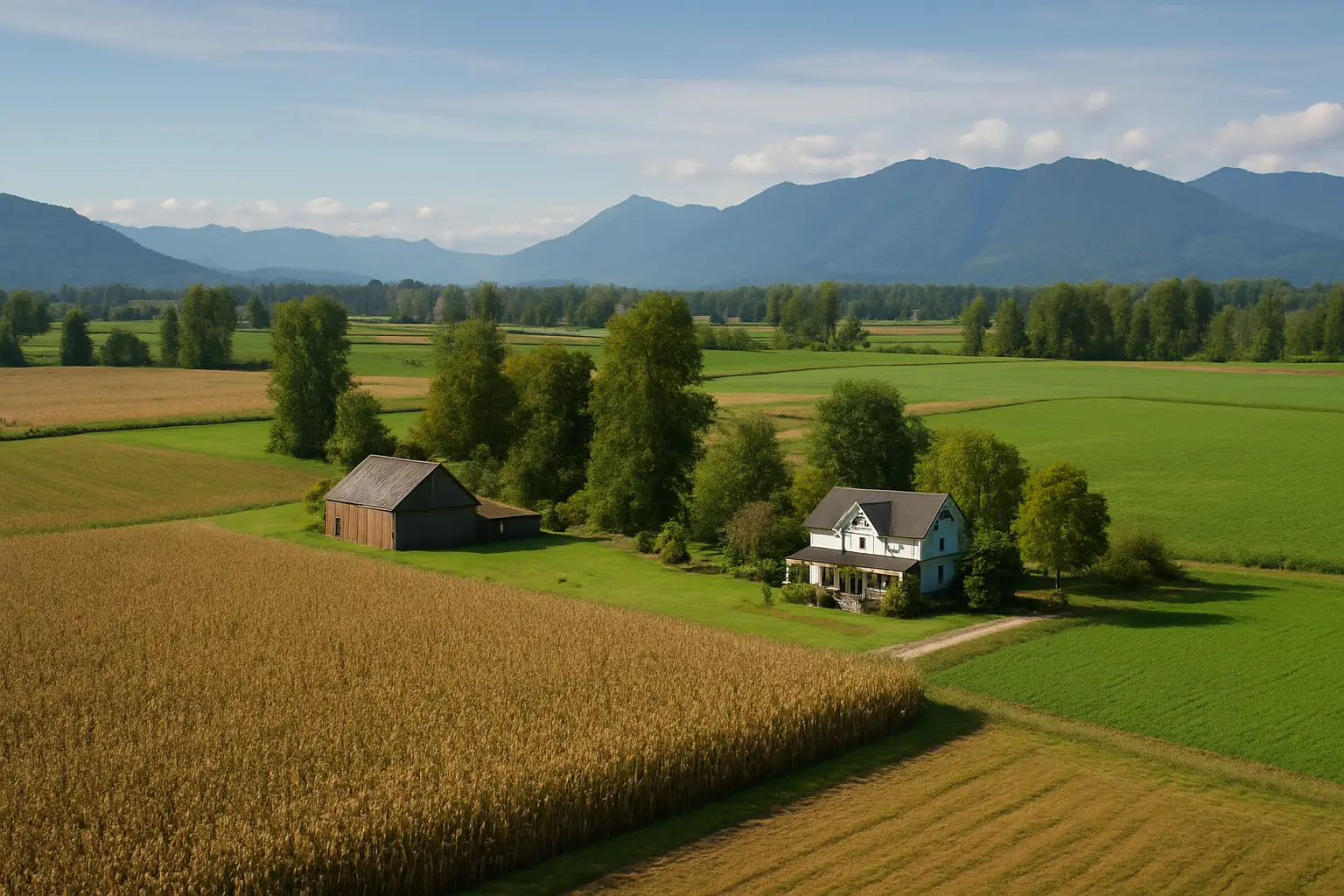
The Agricultural Land Reserve is a provincial land-use zone designed to protect land for agriculture. The Agricultural Land Commission administers the reserve and the provincial rules governing uses within it.
For Abbotsford acreage buyers, being in the ALR creates an important extra layer of due diligence.
The ALC advises prospective buyers to be clear about what they intend to do with a property and to check both ALR requirements and local zoning before buying. It also warns that an existing building or activity on a property should not automatically be assumed to be authorized.
ALR Status Is Not the Same as Zoning
This is one of the most common points of confusion.
ALR status comes from the provincial Agricultural Land Reserve system.
Zoning comes from the City of Abbotsford and governs how individual properties may be used and developed under municipal rules.
An ALR acreage must therefore be evaluated under both systems.
A property can be:
inside the ALR and agriculturally zoned;
partly inside the ALR;
outside the ALR but still subject to restrictive rural zoning;
outside the ALR with another land-use designation.
The label “acreage” does not tell you which situation applies.
What Is Non-ALR Acreage in Abbotsford?
A non-ALR acreage is simply rural or larger-parcel property located outside the Agricultural Land Reserve.
It may remove the additional provincial ALR restrictions, but it does not remove municipal planning rules.
Abbotsford's current planning framework includes its Official Community Plan and Zoning Bylaw. The City adopted its updated Abbotsforward 2050 Official Community Plan in December 2025, along with zoning updates intended to shape future growth.
That is important for buyers using older property information.
A description written several years ago may not reflect today's planning framework. Current zoning, future land-use designations and development permit information should be checked against the City's current records.
Is Non-ALR Acreage Easier to Develop?
Sometimes a non-ALR parcel may have fewer agricultural land-use constraints because ALC rules do not apply.
But fewer ALR constraints does not mean unrestricted development.
A non-ALR parcel can still be affected by:
current zoning;
future land-use designation;
minimum parcel requirements;
road access;
municipal servicing;
setbacks;
environmental conditions;
development permit areas;
building requirements;
subdivision approval.
The City specifically provides current zoning and future land-use information through its Property Information Search and WebMap.
So if a listing says:
“Non-ALR with development potential”
treat the phrase development potential as something to investigate, not as an approval.
Why ALR vs Non-ALR Matters So Much in Abbotsford
Agriculture is a defining land use in Abbotsford.
With approximately 72% of the City's land in the ALR, rural buyers frequently encounter properties where residential goals and agricultural regulations overlap.
That can be particularly relevant when searching rural areas such as:
Bradner;
Mount Lehman;
Matsqui;
Sumas Prairie;
Aberdeen;
other agricultural and rural areas around Abbotsford.
The practical question should not be:
“Is ALR acreage good or bad?”
Instead ask:
“Does this specific property's legal land use work with what I want to do?”
Can You Build a House on ALR Land?
Residential use is possible in the ALR, but it is regulated.
Current ALC guidance says that land in the ALR generally may have no more than one residence per parcel unless it qualifies for an additional residence. The ALC states that most properties can have one principal residence without making an application to the Commission if applicable conditions are met. Local government rules can be more restrictive.
This is why buyers should not conclude that an ALR property cannot have a home.
The more useful questions are:
What residential use is currently permitted?
Is the existing house authorized?
Does Abbotsford zoning permit what I want?
Are there size or siting requirements?
Would another residence be allowed?
Can You Build a Second Home on an Abbotsford ALR Property?
Possibly, but not simply because the acreage is large.
The ALC's current housing guidance states that an additional residence may be available when the applicable requirements are met, while local governments may further regulate the number, size and siting of residences.
Abbotsford's current Agricultural One Zone also contains specific regulations for an Accessory Farm Dwelling Unit and ties that use to Agricultural Land Commission requirements where applicable.
This matters if you are buying acreage with plans such as:
housing parents;
creating a separate family dwelling;
adding another detached home;
replacing an existing dwelling;
creating farm-related accommodation.
Do not base a purchase on the assumption:
“There are ten acres, so another house should be fine.”
Parcel size by itself does not answer the question.
Does Non-ALR Mean You Can Build More Homes?
No.
Being outside the ALR only removes the ALR component of the analysis.
The property's zoning and current municipal regulations still determine what residential uses may be possible. Abbotsford updated its zoning framework through the Abbotsforward 2050 process, making a current property check particularly important in 2026.
If additional housing is central to your plans, verify it for that exact parcel before treating the property as suitable.
Existing Houses and Suites Need to Be Checked Too
Do not focus only on what you want to build later.
The buildings already on the acreage deserve investigation.
The ALC warns prospective buyers that the existence of buildings or ongoing activities does not prove they comply with ALR requirements.
A rural property may include:
a main house;
second residence;
suite;
manufactured home;
barn;
shop;
converted outbuilding;
farm-worker accommodation.
The City of Abbotsford's Property Information Search provides publicly available information including building permits, zoning, legal descriptions and development information.
Ask About Every Major Structure
For each building, consider confirming:
What was it originally approved as?
Is there a building-permit history?
Is its current use permitted?
Can it continue to be used the same way after the purchase?
Could it be replaced if substantially damaged?
Can it be expanded or converted?
The answer may matter as much as the acreage itself.
Can You Subdivide ALR Land in Abbotsford?
Subdivision is one of the clearest differences between ALR and non-ALR property.
The Agricultural Land Commission states that land within the ALR cannot be subdivided unless the subdivision is specifically allowed by the Commission or permitted under regulation.
That means a large parcel is not automatically divisible.
A listing could show 10, 20 or 40 acres and still offer no guaranteed right to create additional lots.
Do Not Confuse Lot Size With Subdivision Approval
A buyer may see a large parcel and think:
“Surely I can split this later.”
That assumption can materially change what someone is willing to pay.
For an ALR property, investigate:
whether subdivision is permitted under ALR rules;
whether an ALC application would be required;
current Abbotsford zoning;
the City's subdivision requirements;
access;
servicing;
physical site constraints.
If the ALC must consider an application, the process generally involves submission through the local government before an application forwarded to the ALC is decided by the Commission.
Is Non-ALR Acreage Automatically Subdividable?
No.
Removing the ALC layer does not create subdivision approval.
The property must still work within Abbotsford's current land-use and subdivision framework. Current zoning and future land use should be investigated through the City's property tools and planning department.
A non-ALR property can still face issues involving:
parcel configuration;
road frontage;
servicing;
zoning;
development permits;
site conditions;
planning policy.
When subdivision is a major reason for buying a property, it deserves its own due-diligence investigation.
What Uses Are Allowed on ALR Acreage?
The ALC identifies agriculture as the priority use in the ALR and provides current guidance on permitted agricultural and other activities. Some permitted uses have conditions, and local government requirements can still apply.
That may include different forms of:
crop production;
livestock farming;
greenhouse activity;
farm structures;
farm-product processing;
farm retail;
certain agri-tourism activities.
But a broad category such as “farm business” is not specific enough to determine whether an individual plan will work.
If you want to buy a property to pursue a particular activity, describe the actual activity.
For example:
“I want to keep four horses and use an existing barn.”
is much easier to investigate than:
“I want a hobby farm.”
Does ALR Land Have to Be an Active Farm?
The ALR designation makes agriculture the priority land use, but a buyer should not assume that every property currently operates as a commercial farm. The ALC also considers agricultural suitability even where land is not currently being used for agriculture.
For a residential buyer, the more important consideration may be that you are purchasing property within an agricultural land-use environment.
That can affect both what you can do with the land and what happens around you.
Rural Living Beside Working Farms
Someone moving from a suburban neighbourhood may be attracted by Abbotsford's open land, privacy and views.
But agricultural areas are working landscapes.
The ALC specifically tells prospective rural-residential buyers to understand the agricultural setting before buying ALR property and to investigate whether their intended use is compatible with the rules governing the land.
When viewing an acreage, pay attention to the surrounding area as well as the house.
Consider:
nearby farm operations;
agricultural vehicles;
seasonal activity;
surrounding land use;
access roads;
how close the house is to active agricultural areas.
A rural setting should fit your actual day-to-day expectations, not just look attractive in photos.
Can You Run a Business on ALR Acreage?
It depends on the business.
Some farm-related and other uses are permitted within the ALR under specified conditions, while other activities may need approval or may not be allowed. Local Abbotsford requirements can apply as well.
Do not assume that a large shop or large parking area means any business can operate from the property.
If your plans include:
contractor operations;
commercial storage;
vehicle storage;
workshops;
events;
retail;
food processing;
accommodation;
home-based business activity;
verify the particular use.
Abbotsford also requires businesses operating in the city to comply with applicable zoning requirements through its business-licensing system.
What About a Business on Non-ALR Acreage?
The same basic principle applies.
Non-ALR status does not automatically make commercial use legal.
A rural property may physically have enough room for trucks, equipment or a large workshop while its zoning does not permit the intended operation.
This is where buyers should separate two questions:
Can the activity physically fit?
and
Is the activity legally permitted?
Both need a satisfactory answer.
Soil and Fill Can Be a Major ALR Issue
Buyers planning major site work should pay particular attention to soil and fill.
The Agricultural Land Commission states that the placement of fill and removal of soil within the ALR are regulated.
That can become relevant if your plans involve:
filling low portions of land;
major grading;
bringing material onto the property;
removing soil;
preparing certain building areas;
changing parts of the site.
The fact that you own a large parcel does not automatically mean you can reshape it without restrictions.
If site work is essential to your plan, verify it before purchasing.
How Do You Check Whether an Abbotsford Property Is in the ALR?
Use the Agricultural Land Commission's current mapping resources.
The ALC's ALR Property and Map Finder allows users to search by civic address or Property Identifier and view ALR status. The Commission says its ALR maps are updated four times per year.
Do Not Rely Only on the Property Title
A title may contain an ALR notation, but the ALC specifically warns that title notation is not a definitive method of confirming whether a parcel is currently inside or outside the reserve.
The Commission gives examples of why:
a title may contain an ALR notation even where the parcel was later found outside the reserve;
a title without the notation may still relate to land inside the ALR;
only part of a parcel may be within the ALR.
Use current mapping and seek clarification where the boundary is uncertain.
What If Only Part of the Acreage Is in the ALR?
Partial ALR inclusion is possible.
The ALC states that when only part of a parcel is within the Agricultural Land Reserve, ALR rules apply to the portion inside the reserve.
This makes the actual location of the ALR boundary important.
For example, you may need to determine whether:
the house is inside the ALR portion;
an outbuilding is inside it;
your proposed building location crosses it;
the area you want to use for a specific purpose is affected.
A listing description saying “partially ALR” is therefore not enough.
Look at the parcel map.
How to Check Abbotsford Zoning and Property Information
The City of Abbotsford provides two particularly useful starting points.
Property Information Search
The City's Property Information Search provides publicly available information such as:
zoning;
legal descriptions;
building permits;
development information;
assessments;
business licences;
service record cards.
Abbotsford WebMap
The City's WebMap allows users to view property information and layers such as:
zoning;
land use;
lot area;
aerial imagery;
City utilities.
These tools are useful for initial research, but a buyer should seek appropriate confirmation where a purchase depends on a particular land use or approval.
Why the Official Community Plan Matters
Current zoning and future land-use planning are not the same thing.
Abbotsford adopted its updated Abbotsforward 2050 Official Community Plan in December 2025. The City describes the OCP as its main long-range planning document, covering matters such as land use, housing, transportation, economic growth and infrastructure planning.
That matters when an acreage is marketed with statements such as:
“future development potential”;
“investment property”;
“future subdivision opportunity”;
“close to future growth.”
A future land-use designation may provide planning context, but it is not the same as having approval to develop today.
ALR vs Non-ALR for a Hobby Farm
If your goal is a hobby farm, do not begin by deciding that ALR or non-ALR is automatically better.
Begin by defining what “hobby farm” means to you.
Buyer A
Wants:
two horses;
an existing barn;
pasture;
one family home;
no subdivision.
Buyer B
Wants:
a large house;
separate family residence;
commercial workshop;
no agricultural operation.
Buyer C
Wants:
berries or vegetables;
greenhouse space;
farm retail;
room for equipment.
Those buyers have completely different land-use questions.
ALR land may align well with genuine agricultural plans, while a non-ALR rural property may be worth investigating for some primarily residential goals. But zoning and parcel-specific rules still determine whether either property actually works.
If you are flexible about location, comparing Fraser Valley acreage listings can help you evaluate whether another rural community offers a property configuration better suited to your goals.
ALR vs Non-ALR for Additional Housing
If another residence is important, make it a major screening question before you spend time comparing finishes or renovations.
On ALR Land
Current provincial rules generally permit one principal residence, with an additional residence possible where the applicable ALR requirements are met. Abbotsford can impose its own local requirements as well.
Outside the ALR
The ALC layer generally disappears, but Abbotsford zoning and development rules still determine what can be built.
Neither situation supports a simple assumption.
ALR vs Non-ALR for Future Development
A buyer focused on redevelopment may initially prefer non-ALR land because it is not subject to the same agricultural reserve rules.
That can be a reasonable factor to investigate.
It is not a guarantee.
For a non-ALR acreage, check:
current zoning;
OCP designation;
development permit areas;
road access;
services;
subdivision requirements;
nearby planning applications;
physical site conditions.
For ALR acreage, those issues remain relevant, with ALR rules added to the analysis.
Five Acreage Assumptions Buyers Should Avoid
1. “Non-ALR Means I Can Develop It”
Not necessarily.
Municipal zoning, planning and development requirements still apply.
2. “ALR Means I Cannot Have a Home”
Incorrect.
Current ALC rules provide for a principal residence subject to applicable requirements, with local government able to regulate further.
3. “There Are Already Two Houses, So Both Must Be Legal”
Do not assume this.
The ALC explicitly warns that existing buildings or uses may not necessarily be authorized.
4. “It Has Enough Acres to Subdivide”
Lot size does not create an automatic subdivision right. ALR subdivision is specifically restricted, while non-ALR subdivision remains subject to local requirements.
5. “The Listing Says Development Potential, So It Has Been Approved”
Marketing language is not the same as municipal or provincial approval.
Confirm the actual land-use status before paying a premium for future potential.
Which Buyer Might Prefer ALR Acreage?
An ALR acreage may deserve closer consideration if you:
genuinely want agricultural land;
intend to pursue a permitted agricultural use;
value living in an agricultural setting;
do not depend on speculative subdivision;
are comfortable working within ALR and City requirements;
have verified that the existing residence and structures meet your needs.
That does not mean ALR land is automatically the better agricultural property. Soil, drainage, property configuration, infrastructure and the actual farm use still matter.
Which Buyer Might Prefer Non-ALR Acreage?
A non-ALR acreage may deserve more attention if you:
specifically want to avoid the extra ALR regulatory layer;
have a primarily residential goal;
want to investigate a non-agricultural use;
are considering additional development;
are considering subdivision;
understand that Abbotsford zoning can still prevent those plans.
The important word is investigate.
Non-ALR status should open another set of questions, not end the due-diligence process.
12 Questions to Ask Before Viewing an Abbotsford Acreage
About ALR Status
Is the entire parcel in the ALR?
Is only part of it in the ALR?
Where does the ALR boundary fall?
About Abbotsford Land Use
What is the current zoning?
What is the current OCP designation?
Are there development permit areas or other known planning constraints?
About Existing Improvements
Are the house, suite, barn, shop and other major structures permitted?
Is their current use authorized?
About Your Plans
Is the use I want permitted?
Could another residence be allowed?
Would subdivision require additional approvals?
Would my proposed business, farm use or site work require municipal or ALC approval?
These questions can help you eliminate properties that look attractive but do not fit your actual plans.
Abbotsford Acreage Due-Diligence Process
Step 1: Identify the Exact Parcel
Do not research only by neighbourhood or listing headline.
Use the exact:
civic address;
legal description where available;
PID.
Step 2: Check ALR Status
Use the ALC's current property mapping system rather than relying only on a listing or title notation.
Step 3: Check Current Abbotsford Zoning
Use the City's current Property Information Search or WebMap.
Step 4: Review Future Land Use
Check the current Abbotsforward 2050 OCP information if future development is relevant to your decision.
Step 5: Define Your Intended Use
Be very specific.
Instead of asking:
“Can I build more?”
ask:
“Could this parcel legally support a second detached residence for my parents?”
Instead of:
“Can I run a business?”
ask:
“Can I operate my specific business from this shop with the equipment and vehicle traffic it requires?”
Specific questions produce better answers.
Step 6: Review Existing Structures
Check permit and development records for the house, suites, barns, shops and other important improvements. Abbotsford's Property Information Search provides a useful public starting point.
Step 7: Verify Any Plan That Affects Your Purchase Decision
If you would not buy the property unless you can:
build another home;
subdivide;
operate a specific business;
keep certain animals;
construct a shop;
add significant fill;
expand existing buildings;
do not leave that question until after closing.
The broader Fraser Valley home-buying process can help you understand where property investigation and due diligence fit into the overall purchase process.
Frequently Asked Questions
What Is the Difference Between ALR and Non-ALR Acreage in Abbotsford?
ALR acreage is located wholly or partly within British Columbia's Agricultural Land Reserve, where agriculture is the priority land use and Agricultural Land Commission rules apply. Non-ALR acreage is outside that reserve but remains subject to Abbotsford's zoning, planning and other applicable regulations.
How Much of Abbotsford Is in the ALR?
The City of Abbotsford reports that approximately 72% of its land base is located within the Agricultural Land Reserve.
Is Non-ALR Land Better in Abbotsford?
Not automatically. It depends on your intended use. Non-ALR land does not have the same provincial agricultural reserve layer, but City zoning and planning rules still determine what can be developed or operated on the property.
Is ALR Land Only for Farmers?
The ALR makes agriculture the priority land use, but residential and other permitted uses can exist subject to the current regulatory framework. Buyers should review the specific permitted-use rules rather than assuming every ALR parcel must operate as a commercial farm.
Can You Build a House on ALR Land in Abbotsford?
Current ALC guidance generally permits one principal residence on an ALR parcel without an ALC application when applicable conditions are satisfied, but local Abbotsford requirements can regulate residential use further.
Can You Build a Second Home on ALR Acreage?
An additional residence may be possible where the relevant provincial and local requirements are met. It should not be assumed merely because a parcel is large.
Can ALR Acreage Be Subdivided?
Only in limited circumstances. The ALC states that ALR land cannot be subdivided unless the subdivision is permitted under regulation or specifically allowed by the Commission.
Can Non-ALR Acreage Be Subdivided?
Potentially, but non-ALR status does not create an automatic subdivision right. Current zoning, planning, servicing, road and other municipal requirements still need to be evaluated.
How Do I Find Out if an Abbotsford Property Is in the ALR?
The Agricultural Land Commission provides an ALR Property and Map Finder that can search by civic address or PID. The ALC recommends using current mapping rather than relying solely on a title notation.
How Can I Check Abbotsford Zoning?
The City provides a Property Information Search and WebMap that contain parcel-specific information, including zoning and land-use data.
Does “Non-ALR” Mean a Property Has Development Potential?
No. It means the property is outside the Agricultural Land Reserve. Development potential is a separate question involving current zoning, the OCP, servicing, subdivision requirements and other property-specific factors.
ALR or Non-ALR: Which Abbotsford Acreage Fits You Better?
There is no universal winner.
For some buyers, ALR acreage provides exactly what they want: agricultural surroundings, land suitable for farming and a property where long-term subdivision is not the goal.
For others, non-ALR acreage may be worth prioritizing because their plans are primarily residential or involve a use that may be difficult to accommodate within the ALR.
But ALR vs non-ALR should be a filter, not your final decision.
The better property is the one where all four of these pieces line up:
1. The physical property works for you.
The house, land, buildings, access and location meet your needs.
2. The current zoning works for you.
Your intended use fits municipal regulations.
3. The ALR status works for you.
If the property is inside the reserve, your plans fit the applicable agricultural land-use rules.
4. Your future expectations are realistic.
You are not paying a premium based only on unverified subdivision, development or additional-housing assumptions.
When comparing Abbotsford acreages, identify those questions before getting attached to a property.
Then verify them against current City of Abbotsford and Agricultural Land Commission information.
That approach makes the comparison far more useful than simply deciding that ALR is restrictive or that non-ALR is automatically more valuable.
The goal is not just to buy land.
It is to buy an Abbotsford acreage where the property, permitted land use and your plans for the future actually fit together.
 The data relating to real estate on this website comes in part from the MLS® Reciprocity program of either the Greater Vancouver REALTORS® (GVR), the Fraser Valley Real Estate Board (FVREB) or the Chilliwack and District Real Estate Board (CADREB). Real estate listings held by participating real estate firms are marked with the MLS® logo and detailed information about the listing includes the name of the listing agent. This representation is based in whole or part on data generated by either the GVR, the FVREB or the CADREB which assumes no responsibility for its accuracy. The materials contained on this page may not be reproduced without the express written consent of either the GVR, the FVREB or the CADREB.