

Buying a newly built condo, townhouse or detached home in the Fraser Valley can be appealing. You may get a modern floor plan, new building systems, contemporary finishes and home-warranty coverage without taking on the immediate renovation decisions that sometimes come with an older property.
But the advertised purchase price is only the starting point.
When buying new construction in the Fraser Valley, BC, buyers may also need to plan for GST treatment, deposits, upgrade costs, closing adjustments, legal expenses, property transfer tax considerations, strata fees, insurance, financing changes between contract and completion, and costs that arise after possession.
For a pre-sale property, there is another important difference: you may sign a binding purchase contract months—or sometimes much longer—before you receive the finished home.
That gap between signing and completing makes new-construction due diligence different from buying an established resale property.
The goal of this guide is not to tell you whether a particular development is a good purchase. It is to help you understand the questions and costs worth reviewing before signing developer paperwork.
For current projects and broader search options, start with The Valley Life's Fraser Valley new construction guide.
Quick Answer: What Costs Should You Budget for Beyond the New Home's Purchase Price?
Depending on the property and your circumstances, a Fraser Valley new-construction buyer may need to consider:
GST and any applicable new-housing rebate treatment;
scheduled deposits;
legal or notary fees;
property transfer tax, subject to any exemption for which you qualify;
completion adjustments;
optional upgrades;
appliance or window-covering costs if not included;
moving expenses;
initial insurance costs;
mortgage appraisal or financing-related costs;
strata fees for a condo or townhouse;
move-in or strata-related charges where applicable;
utility setup;
deficiency follow-up;
landscaping or exterior work for certain detached homes;
future ownership costs once warranties expire.
For a pre-sale, buyers should also understand what happens if mortgage rates, qualification rules, income, employment, property values or personal circumstances change between the contract date and completion.
The correct affordability question is therefore not:
“Can I afford the advertised price?”
It is:
“Can I afford the deposit schedule, completion costs and eventual monthly ownership cost—and still complete if circumstances change?”
Use The Valley Life's mortgage calculator and True Home Cost tools before narrowing your search.
Why New Construction Requires a Different Buying Mindset
A resale purchase normally involves a home that already exists.
You can walk through it, inspect its current condition, review available documents and negotiate around a relatively near-term completion date.

A pre-sale purchase is different.
BCFSA explains that when you purchase a pre-sale unit, you are generally buying the right to receive a completed property in the future. Deposits are paid according to the purchase contract, and the remaining balance is due when the unit is ready for completion or occupancy under the contract.
That creates uncertainty around:
exact completion timing;
future mortgage qualification;
final interest rates;
neighbourhood construction;
final views;
finished dimensions;
strata operating costs;
your own employment or family circumstances.
New construction can still be the right choice.
It simply requires a different kind of preparation.
1. Start by Asking Whether GST Is Included in the Price
One of the first questions Fraser Valley new-home buyers should ask is:
Does the advertised price include GST, or is GST payable in addition to that price?
Do not assume.
The wording of the purchase contract matters.
GST can apply to purchases of newly constructed homes from builders, while various federal new-housing rebate programs may apply in qualifying circumstances. The federal rules also changed recently: a new first-time home buyers' GST/HST rebate received Royal Assent in March 2026 and is now available to qualifying purchasers of certain newly constructed or substantially renovated homes.
Questions to Ask About GST
Before comparing the developer's price with resale listings, ask:
Is GST included in the stated purchase price?
Is GST payable on top of the price?
Has the developer assumed that a particular rebate will be assigned or credited?
What happens if I do not qualify for the assumed rebate?
Is my intended use of the property relevant to rebate eligibility?
What documentation will I need?
Who should verify my eligibility?
Tax treatment depends on the buyer, property, contract and intended use.
Do not rely on a sales-centre estimate as tax advice.
For a material purchase decision, confirm the current treatment with an accountant, lawyer, tax professional or the Canada Revenue Agency as appropriate.
2. Do Not Forget B.C. Property Transfer Tax
Buying a new home does not automatically mean there will be no property transfer tax.
However, B.C. has a newly built home exemption that can reduce or eliminate property transfer tax for qualifying purchasers of eligible newly built principal residences.
Eligibility depends on current criteria including the property's value, purchaser circumstances and occupancy requirements. The provincial program also has specific rules about moving into and occupying the property.
Why You Should Check This Before Signing
Your expected closing cost can change substantially depending on whether you qualify for an exemption.
Ask your lawyer or notary to help you establish:
whether the property is eligible;
whether you personally qualify;
what occupancy requirements apply;
what documentation is required;
whether another property transfer tax program may be relevant.
Do not budget based solely on what another buyer in the same project paid.
Their tax situation may be different from yours.
3. Understand the Deposit Schedule
Pre-sale deposits are different from a typical resale deposit because they may be collected in stages over a longer period.
BCFSA notes that a purchaser may pay an initial deposit when signing and may have additional deposits due according to the schedule in the pre-sale contract. Deposits are held in trust by a lawyer, notary or real estate brokerage.
Ask for the Entire Deposit Schedule
You should know:
the initial deposit;
every subsequent deposit;
exact due dates or triggering events;
the total percentage or amount required before completion;
acceptable payment methods;
consequences of missing a deposit deadline;
whether any deposits are refundable and under what circumstances.
Do Not Confuse Deposit Affordability With Purchase Affordability
Having enough cash for the deposits does not prove that you will be able to complete the purchase.
Your lender will eventually need to approve financing based on the circumstances and requirements applicable closer to completion.
Keep a separate plan for:
mortgage qualification;
closing costs;
emergency savings;
moving costs;
furniture;
post-possession expenses.
4. Read the Developer's Disclosure Statement
For a pre-sale development in British Columbia, the disclosure statement is a central due-diligence document.
BCFSA states that a developer must provide purchasers with a disclosure statement describing material facts about the development before selling a pre-sale unit. Buyers should also review amendments that may be issued later.
The disclosure statement can contain information about matters such as:
estimated construction dates;
estimated strata fees;
proposed strata bylaws;
parking;
the development structure;
purchaser rights;
contractual matters;
other material facts concerning the project.
Since April 2025, There Is Additional Buyer-Focused Disclosure
BCFSA now requires applicable pre-sale disclosure statements to include a Summary of Pre-sale Risks and Buyer Rights form at the front.
The form is intended to highlight important contractual rights, risks and sections of the disclosure statement that deserve attention.
Treat that summary as a navigation tool—not a substitute for reading the complete disclosure statement.
5. Have the Purchase Contract Reviewed Before You Commit
A developer's purchase contract may be substantially different from a familiar resale contract.
It has been prepared for the development and can include detailed provisions governing the relationship between developer and purchaser.
BCFSA strongly recommends obtaining independent professional advice before entering into a pre-sale contract.
Contract Questions Can Include
Ask your lawyer or other appropriate professional to help you understand provisions involving:
completion dates;
extensions;
developer termination rights;
purchaser default;
deposits;
assignment;
changes to plans or specifications;
measurement differences;
parking;
storage;
upgrades;
completion adjustments;
occupancy;
deficiency processes;
notices;
tax treatment;
what happens if financing is unavailable at completion.
This is one area where trying to save a small amount on independent advice can create disproportionate risk.
A developer contract is a legal document.
A real-estate article cannot tell you what a particular clause means for your rights.
6. Know About the Pre-Sale Rescission Period
For qualifying B.C. pre-sale purchases, BCFSA states that purchasers have a seven-day period to cancel the pre-sale contract without penalty after the later of signing the contract and acknowledging an opportunity to review the disclosure statement.
That period should be used carefully.
It can give you time to:
obtain independent legal review;
speak with your mortgage professional;
review the disclosure statement;
confirm deposit funding;
investigate GST and tax questions;
compare alternatives;
reconsider whether the property still fits.
Do not interpret the rescission period as a reason to sign casually.
It is still better to understand as much as possible before signing.
7. Understand Assignment Terms Before Assuming You Can Sell the Contract
Plans change.
A buyer may sign a pre-sale contract and later:
relocate;
lose a job;
have a child;
separate from a partner;
experience financing problems;
decide they no longer want the property.
That does not necessarily mean the contract can simply be transferred to another buyer.
BCFSA advises that pre-sale assignments depend on what the contract permits. Assignment fees and other conditions may apply, and the financial risks associated with a pre-sale continue for an assignee.
Before Signing, Ask:
Is assignment allowed?
Does the developer need to approve it?
Is there an assignment fee?
Can the developer refuse an assignment?
Are there restrictions on when assignment is permitted?
What documents are required?
Are there tax consequences?
Am I released from my obligations after an assignment?
The final question is particularly important and should be answered by your legal and tax professionals—not assumed.
8. Budget for Completion Adjustments
The amount due at completion may not simply be:
purchase price minus deposits.
A statement of adjustments can include additional credits and charges depending on the contract and property.
Possible items may involve:
property taxes;
strata fees;
utilities;
prepaid expenses;
contractual adjustments;
other developer charges permitted under the agreement.
The exact items are contract-specific.
Ask Before You Sign
Instead of waiting for the closing statement, ask:
What types of completion adjustments does this contract permit?
Are there utility or connection charges?
Are there strata-related adjustments?
Are there legal or administrative charges payable by the purchaser?
Are there other amounts beyond the balance of the purchase price?
Your lawyer or notary should review the actual contract and final statement of adjustments.
9. Upgrades Can Change the Real Purchase Price Quickly
The base model may not be the home you actually want.
Depending on the development, buyers may be offered upgrades involving:
flooring;
appliances;
cabinetry;
countertops;
lighting;
plumbing fixtures;
air conditioning;
EV charging;
storage;
closet systems;
electrical packages;
smart-home equipment.
An extra amount here and another amount there can materially change the final cost.
Build an Upgrade Budget Before Visiting the Design Centre
Divide possible changes into three groups.
Must Have
Items that would be difficult or disproportionately expensive to add later.
Nice to Have
Features that improve the home but are not essential.
Easy to Add Later
Items that can be upgraded after possession without major disruption.
This helps protect you from turning an affordable base price into a purchase that stretches your finances.
10. Check Exactly What the Purchase Price Includes
Marketing photographs and display suites are designed to show the project attractively.
Not everything shown will necessarily be included with your unit.
Verify:
appliance package;
flooring;
air conditioning;
blinds;
closet organizers;
lighting;
balcony or patio finish;
landscaping;
fencing;
EV charging;
parking;
storage;
amenity access.
Ask for inclusions in writing and compare them with the contract and disclosure documents.
Do not make a large purchase based on a verbal statement at a sales centre.
11. Estimated Strata Fees Are Only Estimates
For new condos and strata townhouses, monthly fees can form an important part of the affordability calculation.
BCFSA notes that estimated strata fees are among the information buyers can review in a pre-sale disclosure statement.
The important word is estimated.
An operating budget prepared before a building has a long history may not perfectly predict future:
insurance;
utilities;
landscaping;
cleaning;
property management;
repairs;
snow removal;
amenity expenses;
reserve contributions.
Ask What's Included in the Estimate
For example:
hot water?
water?
gas?
landscaping?
amenities?
insurance?
building maintenance?
waste collection?
Two projects with similar advertised strata fees may offer very different services.
12. Understand B.C.'s New Home Warranty
New homes built by licensed residential builders in B.C. generally require third-party home warranty insurance.
BC Housing describes the minimum protection as 2-5-10 home warranty insurance, covering specified defects in labour and materials, the building envelope and structural components for different periods.
At a high level:
2 years relates to specified labour and material coverage;
5 years covers specified building-envelope defects, including unintended water penetration;
10 years applies to specified structural defects.
The detailed start dates, exclusions, limits and coverage differ by circumstance.
Warranty Does Not Mean Everything Is Covered
BC Housing specifically notes that home warranty insurance addresses certain construction defects. It does not automatically cover cosmetic issues, personal preferences or every contractual expectation.
Before purchasing, ask:
Who is the warranty provider?
When does coverage begin?
What does the policy cover?
What is excluded?
How are claims made?
What deadlines apply?
Who handles builder service requests before a warranty claim?
BC Housing's New Homes Registry can also be used to confirm builder and warranty information for registered properties.
13. Treat the Deficiency Walkthrough Seriously
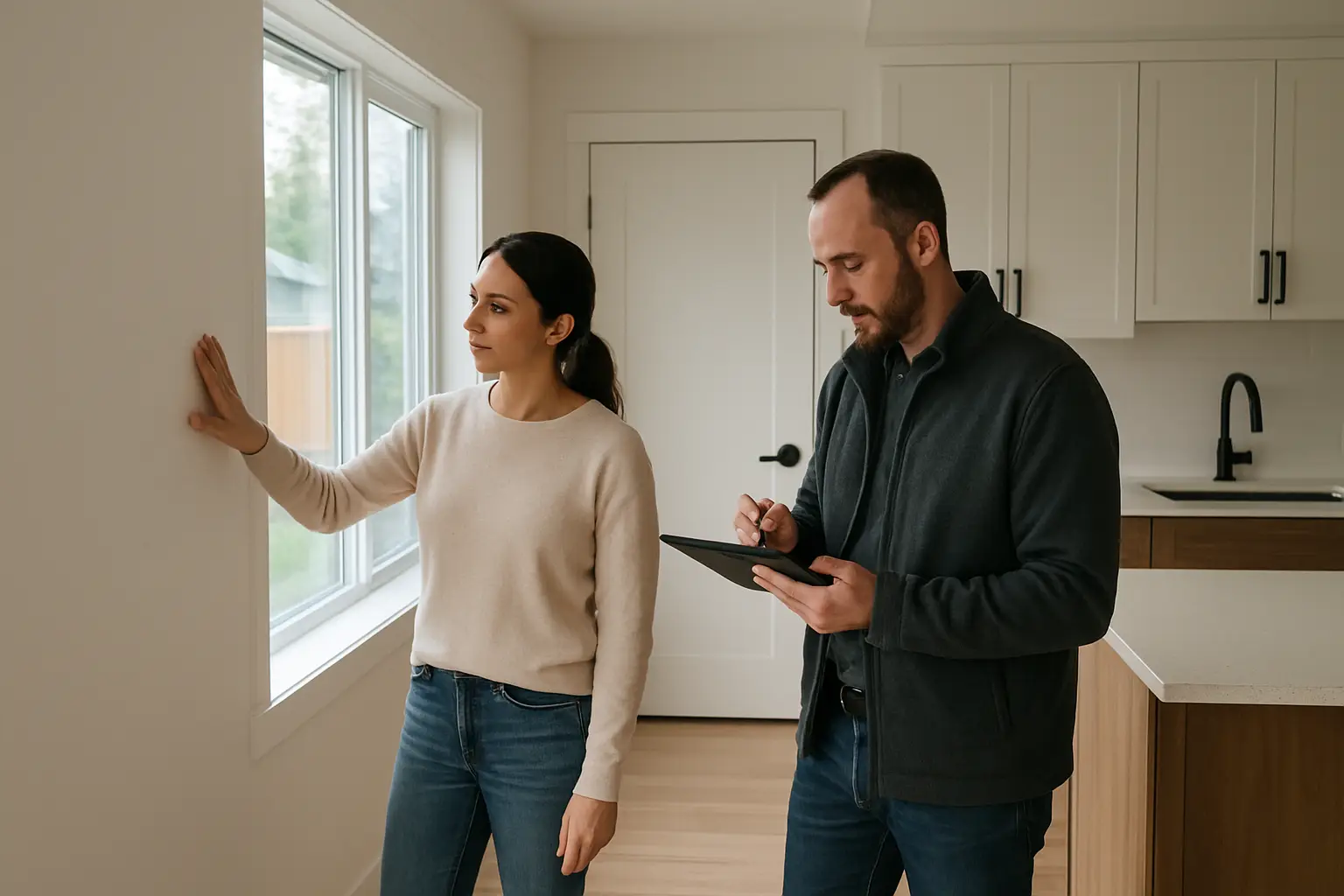
A new home can still have deficiencies.
Before or around possession, depending on the project's process, buyers may have an opportunity to identify incomplete work or visible items requiring attention.
Potential examples could involve:
paint;
flooring;
cabinetry;
doors;
trim;
fixtures;
appliances;
windows;
electrical components;
plumbing fixtures;
incomplete finishing.
Be Systematic
Bring:
your contract specifications;
upgrade selections;
appliance list;
a phone or camera;
notes.
Document what you observe clearly.
Also understand the difference between:
a cosmetic deficiency;
unfinished contractual work;
a builder service issue;
a condition that could potentially fall under home warranty.
If an issue appears technically significant, use the appropriate qualified professional rather than trying to diagnose it yourself.
14. Financing Timing Is One of the Biggest Pre-Sale Risks
A pre-sale deposit can be paid today while mortgage completion occurs much later.
Your current pre-approval is not necessarily a guarantee of financing at completion.
Over time, any of the following can change:
interest rates;
lender policies;
mortgage qualification rules;
employment;
income;
debt;
credit;
property valuation;
appraisal results;
personal circumstances.
BCFSA specifically identifies market changes and the risk of being unable to complete as important considerations in pre-sale purchases.
Ask Your Mortgage Professional:
How long is my current approval valid?
When should we update the file?
What happens if completion is delayed?
Will the lender require an appraisal?
What if the appraised value is below the contract price?
How much cash should I preserve as a buffer?
What changes to my finances should I avoid before completion?
Do not take on new debt casually between signing and closing.
A new vehicle loan or large credit balance can affect mortgage qualification.
15. Understand the Risk of an Appraisal Shortfall
Imagine you agree to buy a pre-sale home well before completion.
If the market changes, a lender may later value the completed property differently from your contract price.
If the lender bases financing on a lower valuation, the purchaser may need more cash to complete.
That is one reason buyers should avoid treating the minimum deposit as the only savings they will ever need.
Maintain financial flexibility where possible.
16. Look at Future Development Around the Property
Fraser Valley new construction often occurs in areas that are still evolving.
That can be positive.
New development may bring:
shops;
schools;
parks;
roads;
transit;
services;
additional housing.
But it can also mean years of:
construction noise;
truck traffic;
temporary road conditions;
neighbouring buildings under construction;
changing views;
future density.
Questions to Ask
Before buying, investigate:
Is this project part of a larger phased development?
What phases remain?
Where will they be built?
Could future buildings affect views or sunlight?
Are amenities complete or planned for later phases?
Is nearby land designated for future development?
Are major roads or infrastructure projects planned nearby?
Do not assume the presentation-centre view represents the permanent surrounding environment.
Municipal plans and zoning information can provide additional context.
17. Parking and Storage Deserve Their Own Review
Never assume the parking or storage arrangement from a floor plan or sales conversation.
Verify:
number of parking stalls;
legal nature of the parking right;
stall location;
stall dimensions;
EV capability;
visitor parking;
storage allocation;
storage location;
whether extra parking or storage costs more.
For households with two vehicles, trades equipment, bikes, strollers or recreational gear, this can materially change whether the property works.
18. Think About the Cost of Furnishing a Brand-New Home
A completely new home can create surprisingly high move-in spending.

Depending on what is included, buyers may need:
blinds;
curtains;
furniture;
shelving;
closet systems;
light fixtures;
patio furniture;
landscaping items;
security equipment;
appliance accessories;
storage systems.
These costs rarely determine whether you should buy the property.
But they belong in your cash-flow plan.
Leaving every dollar available for the down payment and closing can make the first months of ownership unnecessarily stressful.
19. Compare New Construction With Resale on Equal Terms
A new home and an existing home should not be compared solely by asking price.
New Construction May Offer
modern layouts;
newer building systems;
contemporary finishes;
lower immediate renovation needs;
warranty coverage;
energy-efficient features;
newer EV infrastructure.
Resale May Offer
an established neighbourhood;
immediate physical inspection;
known strata-fee history;
existing meeting minutes and financial records;
completed landscaping;
fewer uncertainties about surrounding construction;
potentially more included upgrades.
There is no universal winner.
Compare the true cost, timeline and uncertainty of each option.
20. A Fraser Valley New Construction Cost Checklist
Before deciding that a new home fits your budget, work through each category.
Purchase and Tax
Contract purchase price
GST treatment confirmed
Potential GST/HST rebate eligibility reviewed
Property transfer tax reviewed
Newly built home exemption eligibility checked
Other tax questions reviewed with an appropriate professional
Deposits
Initial deposit
Second deposit
Any later deposits
Total deposit before completion
Deposit deadlines
Source of deposit funds
Closing
Lawyer or notary fees
Statement-of-adjustment items
Mortgage-related costs
Insurance
Moving costs
Utility setup
Cash reserve after completion
Property
Parking
Storage
Appliance package
Upgrade package
Window coverings
EV charging
Air conditioning
Outdoor-space finishing
Strata Property
Estimated strata fees
What's included in strata fees
Proposed bylaws
Amenities
Parking rights
Storage rights
Contract and Development
Disclosure statement
Amendments
Summary of Pre-sale Risks and Buyer Rights
Completion provisions
Extension provisions
Assignment provisions
Developer termination provisions
Phased-development information
Future construction around the unit
Warranty and Completion
Builder confirmed
Warranty provider confirmed
New-home warranty documents
Deficiency process
Warranty claim process
Important warranty dates recorded
Financing
Mortgage affordability tested
Completion financing discussed
Interest-rate change scenario tested
Appraisal-shortfall scenario considered
Cash buffer maintained
Financing re-check scheduled before completion
Questions to Ask Before Signing a Fraser Valley Developer Contract
What exactly is included in the purchase price?
Get clarity on parking, storage, appliances, finishes, upgrades and other advertised features.
Is GST included?
Confirm both the contract treatment and any rebate assumptions.
How much must I pay before completion?
Review every deposit, not just the first one.
When is completion expected?
Also understand the contractual provisions for changing that date.
Can the developer make changes?
Have your lawyer explain provisions dealing with dimensions, materials, plans, amenities and specifications.
Can I assign the contract?
Do not assume. Review assignment provisions and costs.
What happens if I cannot obtain financing?
Understand your contractual exposure before signing.
What are the estimated strata fees?
For a strata property, also ask what the estimate includes.
What warranty applies?
Confirm the builder, warranty provider and exact policy.
Is this part of a larger development?
Understand future phases and nearby construction.
Frequently Asked Questions
Is GST payable on a new construction home in BC?
GST can apply to newly constructed housing. The exact treatment depends on the transaction, including whether the advertised price includes tax and whether a buyer qualifies for an applicable rebate. Confirm the treatment in the contract and obtain current professional tax advice rather than relying on a general rule.
Is there a GST rebate for first-time buyers buying new construction?
Yes, a federal first-time home buyers' GST/HST rebate is now available for qualifying new or substantially renovated homes under eligibility rules that took effect following Royal Assent in March 2026. Eligibility depends on factors including purchaser status, contract timing, construction timing, value and use of the home.
Do new homes in BC qualify for a property transfer tax exemption?
Some qualifying newly built homes may be eligible for B.C.'s newly built home exemption. Property value, purchaser status, property use and occupancy requirements apply. Check the current provincial criteria for your specific purchase.
What is the 2-5-10 new home warranty in BC?
It is B.C.'s minimum third-party home warranty framework for qualifying new homes built by licensed residential builders. It provides specified coverage for labour and materials, building-envelope defects and structural defects over different periods. Policy terms, commencement dates, limits and exclusions should be reviewed for the specific home.
Can a developer change my completion date?
Pre-sale contracts may contain provisions dealing with completion dates and extensions. The exact rights of the developer and purchaser depend on the contract. Have a lawyer review those clauses before signing.
Can I assign my presale contract if my plans change?
Only if the contract permits it and applicable conditions are satisfied. Developer consent, fees and restrictions may apply. Obtain independent legal and tax advice before relying on an assignment as an exit strategy.
Are estimated strata fees guaranteed?
Do not assume they are. A disclosure statement may provide estimated strata fees for a new development, but actual future operating costs can change once the strata is functioning.
Should I have a lawyer review a presale contract?
BCFSA strongly recommends independent professional advice when entering a pre-sale purchase because the purchase contract and disclosure statement affect the buyer's legal rights and obligations.
Can I cancel a BC pre-sale contract after signing?
BCFSA's current consumer guidance describes a seven-day cancellation period for applicable pre-sale contracts, calculated from the later of signing the contract and acknowledging an opportunity to review the disclosure statement. Other cancellation rights may depend on legislation and the specific circumstances.
Final Takeaway: Calculate the True Cost Before You Buy New
The main mistake when buying new construction in the Fraser Valley, BC is treating the advertised price as the entire financial decision.
The better calculation includes:
purchase price + taxes + deposits + closing adjustments + upgrades + financing risk + monthly ownership costs + the cash you need after possession.
Then add the contractual questions.
What happens if completion moves?
What happens if financing changes?
Can the contract be assigned?
What exactly are you getting?
Which costs are estimates rather than guarantees?
What warranty applies?
What will still be under construction after you move in?
A well-chosen new home can be an excellent fit, but the decision should be made from the contract and full cost—not the display suite alone.
Start by exploring Fraser Valley new construction.
Then compare the payment scenarios with the mortgage calculator and review broader ownership expenses through The Valley Life's True Home Cost tools.
When you are ready to take a particular project seriously, learn more about buying with The Valley Life and get buyer representation before signing developer paperwork, so the property, contract, financing timeline and true cost can be reviewed together.
 The data relating to real estate on this website comes in part from the MLS® Reciprocity program of either the Greater Vancouver REALTORS® (GVR), the Fraser Valley Real Estate Board (FVREB) or the Chilliwack and District Real Estate Board (CADREB). Real estate listings held by participating real estate firms are marked with the MLS® logo and detailed information about the listing includes the name of the listing agent. This representation is based in whole or part on data generated by either the GVR, the FVREB or the CADREB which assumes no responsibility for its accuracy. The materials contained on this page may not be reproduced without the express written consent of either the GVR, the FVREB or the CADREB.