.png)

Selling an acreage in the Fraser Valley usually involves more property information than selling a conventional suburban home.
A buyer may want to understand not only the house, but also the land, outbuildings, water source, septic system, access, permits, title charges, Agricultural Land Reserve status and any farm or rental arrangements connected with the property.
That makes document preparation an important part of getting a rural property ready for market.
You do not need to produce every possible record before speaking with a real estate professional, and not every document in this guide will apply to every acreage. The objective is simpler: gather what you already have, identify obvious gaps and make it easier to answer legitimate buyer questions accurately.
If you are considering a sale, start with selling with The Valley Life or request a free home and acreage evaluation to build a property-specific pre-listing plan.
What Documents Should You Gather Before Selling a Fraser Valley Acreage?
A useful pre-listing file commonly includes records relating to:
Title and registered charges
Surveys and site plans
Building permits and renovation records
Well and septic systems
Maintenance and major improvements
Barns, shops and other outbuildings
Leases, rentals and tenancies
ALR and farm-related information
Warranties and equipment records
Utilities and rural services
The exact list depends on the property.
A five-acre residential acreage in Langley will not have the same documentation as a working farm in Abbotsford, an equestrian property in South Langley or a rural holding in Mission with a well, septic system and several detached structures.
The goal is therefore property-specific organization, not paperwork for the sake of paperwork.
Why Gather Acreage Documents Before the Listing Goes Live?
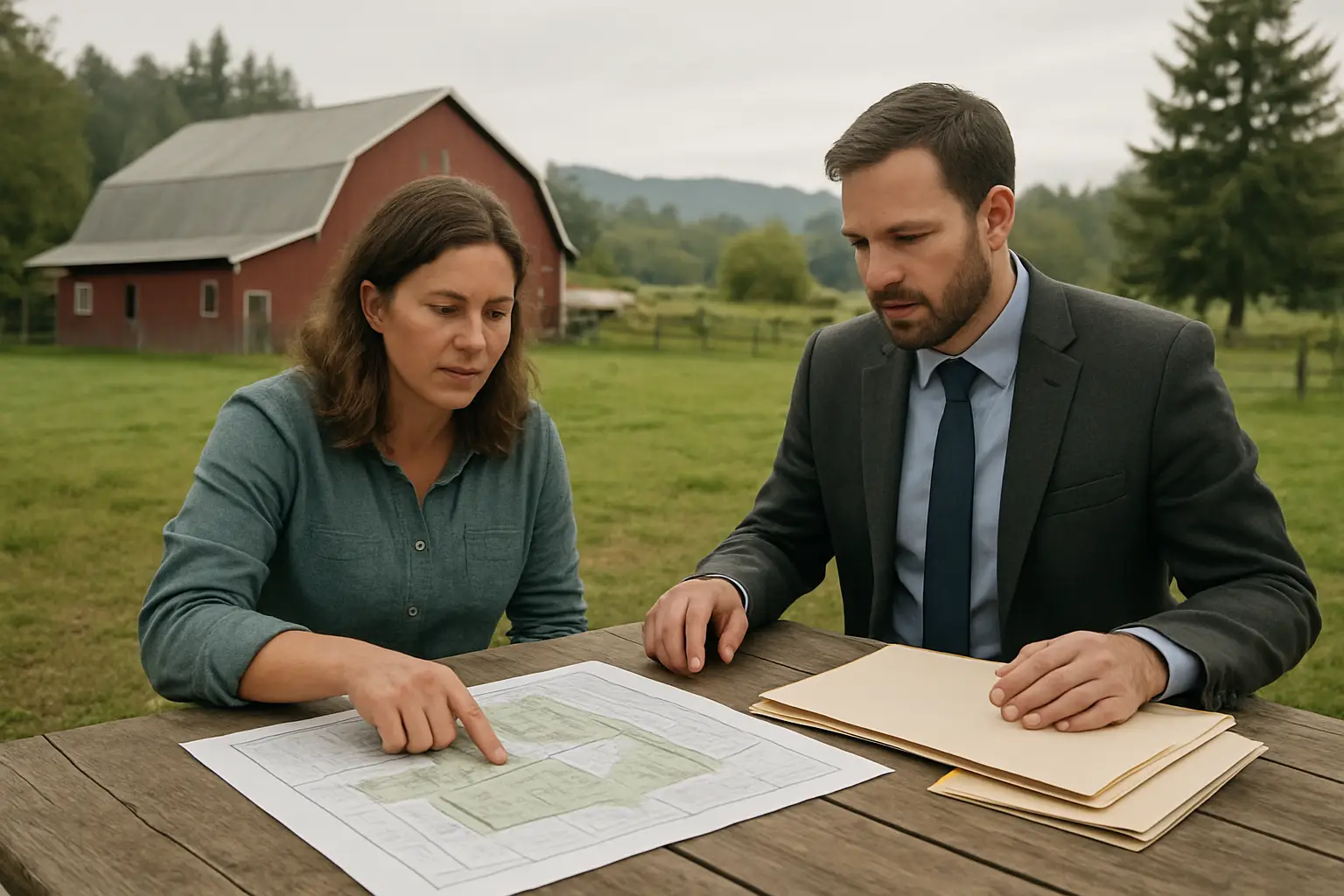
Rural buyers often conduct deeper property-level due diligence because there are more systems, structures and land-use questions to understand.
Preparing documents early can help your listing team:
describe the property more accurately;
identify questions that should be researched before marketing;
avoid relying on memory for important details;
respond more efficiently when serious buyers request information;
distinguish documented improvements from seller assumptions;
identify issues that may need advice from a lawyer, municipality, surveyor, septic professional, well specialist or another qualified professional.
It also helps keep marketing language accurate.
For example, there is an important difference between saying:
“Large detached shop”
and saying:
“Large detached shop; seller has provided building records dated _____.”
The second statement is based on information that can actually be reviewed.
1. Obtain the Current Title and Review Registered Charges
Start with the legal property itself.
A B.C. land title identifies the registered owner and can show legal interests or charges registered against the property. LTSA identifies examples including mortgages, statutory rights of way, easements, covenants, judgments, leases and builders liens.
Do not assume you remember everything registered against a property simply because you have owned it for years.
Useful items to collect
Current title
Legal description
Parcel Identifier, or PID
Copies of relevant registered charges where available
Easement documentation
Statutory right-of-way information
Restrictive covenants
Registered lease information, if applicable
A title search is a snapshot of information in the land title register at the time it is produced, so your real estate and legal professionals may obtain or recommend updated information during the transaction.
Why this matters on an acreage
A right of way crossing the back of a residential lot may be relatively straightforward.
On an acreage, however, an easement or statutory right of way could intersect with a driveway, field, proposed building area, utility corridor or another part of the land a buyer considers important.
Do not interpret registered charges for buyers yourself. Gather the information and let the appropriate professionals address legal implications.
2. Find Surveys, Site Plans and Property Drawings
If you have a survey, site plan or other professionally prepared property drawing, add it to your pre-listing folder.
Depending on what is available, these records can help buyers and professionals understand where improvements are located in relation to property boundaries and other site features.
Look for documents such as:
Legal surveys
Site plans
Building location plans
Subdivision plans
Septic field plans
Well-location information
Drainage plans
Plans prepared for renovations or additions
Do not label an old sketch or informal drawing as a current legal survey if it is not one.
Instead, identify exactly what the document is and when it was prepared.
LTSA also provides access to land-title and plan information and identifies the PID as the unique nine-digit number associated with a parcel in the B.C. land title register.
3. Gather Building Permits and Renovation Documentation
Fraser Valley acreages often contain more than the original residence.
Over the years, owners may have added decks, suites, additions, shops, barns, garages, workshops, retaining structures or other improvements.
Before listing, make an inventory of significant work completed during your ownership.
Then gather whatever supporting records you have.
Your folder may include:
Building permits
Occupancy documentation, where applicable
Approved plans
Electrical records
Plumbing records
Engineering reports
Contractor invoices
Renovation contracts
Addition plans
Receipts for major improvements
In B.C., building and development administration is substantially connected with local governments, and the Province's Building Permit Hub directs applicants to the applicable local government or First Nation permitting process.
If you cannot find an old permit, do not guess.
Make a note of what was built and approximately when, then discuss with your listing professional whether additional municipal research is appropriate before marketing the improvement.
4. Organize Well and Septic Records
Well and septic information can become particularly important when selling rural property in the Fraser Valley.
If your acreage is not fully connected to municipal water and sewer services, buyers may ask for information about the systems serving the property.
For a private well, look for:
Well construction or drilling records
Pump replacement invoices
Water treatment equipment information
Filtration or softener records
Previous water-quality test results
Maintenance invoices
Well-location information
HealthLink BC states that owners of private wells serving a single household are responsible for testing their water and recommends keeping test results for future reference.
That makes an organized history useful even if a buyer ultimately performs independent testing.
For a septic or onsite sewage system, look for:
Installation documentation
System plans
Tank location
Field location
Maintenance records
Pump-out receipts
Repair invoices
Inspection reports
Upgrade information
B.C.'s provincial guidance recognizes onsite sewage systems as part of land-use and sewage-management considerations.
Do not promise that an older well or septic system meets a particular standard unless that conclusion has been provided by an appropriately qualified professional.
5. Build a Major Maintenance and Improvement History
Acreage ownership can involve substantial infrastructure that a normal residential listing never has to explain.
Create a simple timeline of meaningful work completed on the property.
You do not need every receipt for every repair.
Focus first on major items.
Examples include:
Roof replacement
Furnace or heat-pump replacement
Hot-water equipment
Electrical upgrades
Drainage work
Driveway improvements
Culvert work
Perimeter drainage
Retaining walls
Fencing
Barn repairs
Shop improvements
Septic repairs
Well pump replacement
Water treatment systems
Generator installation
Irrigation work
For each major project, record:
What was done → approximately when → who completed it → what documentation remains.
This helps your listing team distinguish meaningful property improvements from ordinary maintenance.
6. Document Barns, Shops and Other Outbuildings Separately
One of the easiest mistakes when preparing an acreage for sale is treating every detached structure as simply “another building.”
A serious rural buyer may have very specific plans for a barn, shop, greenhouse, machine shed, detached garage or storage building.
Create a separate record for each significant structure.
Include what you know about:
Approximate year built
Dimensions
Intended or current use
Electrical service
Heating
Plumbing
Water service
Foundation
Roof age
Significant renovations
Permits or plans in your possession
Equipment included or excluded from the sale
Be precise.
If you do not know the exact square footage or construction date, do not convert an estimate into a fact simply because it makes the listing description sound better.
That is particularly important with older Fraser Valley acreages where buildings may have been constructed or altered under different owners over many decades.
7. Gather Lease, Rental and Tenancy Information
Some acreages have arrangements that are easy to forget because they have existed informally for years.
Examples can include:
A rented residence or suite
A caretaker arrangement
Agricultural land leased to another farmer
Barn or stall rental
Equipment storage
Field use
Seasonal agreements
Other occupancy arrangements
If somebody other than the owner occupies, rents or uses part of the property, tell your real estate professional early.
Gather:
Written agreements
Renewal dates
Rent information
Deposits, if applicable
Notices
Amendments
Contact information
Details of what area is included in the arrangement
Do not attempt to terminate or change a tenancy or lease simply because you plan to sell without first obtaining appropriate professional advice.
A buyer needs a clear picture of which areas will be vacant at completion and which rights or arrangements may continue.
8. Collect ALR and Farm-Related Records
This is especially important for Fraser Valley agricultural and rural properties.
The Agricultural Land Reserve is a provincial land-use zone where agriculture is the priority use. The ALC notes that local zoning does not override ALR requirements, while local governments may impose rules that are more restrictive.
If your property is within the ALR, gather information relating to its status and any history you know about.
Relevant records may include:
ALR property information
Previous ALC applications
ALC decisions
Notices of Intent
Soil or fill approvals
Subdivision decisions
Non-farm-use approvals
Farm-use documentation
Correspondence with the ALC
Correspondence with the municipality
Documents relating to additional residences or other regulated uses
The ALC provides a property-and-map finder for checking ALR status and maintains information about applications, land uses and regulations affecting ALR properties.
Fill placement and soil removal within the ALR are also regulated, with different activities potentially permitted, requiring a Notice of Intent or requiring an application.
If substantial fill, grading or soil removal has occurred on your acreage, tell your listing professional rather than waiting for a buyer to raise the question.
9. Find Warranties, Manuals and Equipment Information
A rural property may include systems and equipment that buyers will inherit.
Create one folder for transferable warranties, manuals and operating information.
Examples might include:
Well pump
Water treatment system
Septic components
Generator
Heat pump
Furnace
Hot-water system
Irrigation system
Gate operators
Security systems
Solar equipment
Barn equipment
Appliances included in the sale
Check whether a warranty is actually transferable before describing it that way.
A useful label is:
“Warranty documentation available — transferability to be confirmed.”
That is better than assuming the next owner automatically receives the remaining coverage.
10. Create a Rural Utilities and Services Sheet
Buyers comparing Fraser Valley acreages may want to understand how the property operates month to month.
Create a simple sheet listing the services serving the property.
Include, where applicable:
Municipal or private water
Well
Septic
Electricity
Natural gas
Propane
Heating oil
Internet provider
Garbage collection
Recycling
Irrigation
Generator
Security
Private road or driveway maintenance
Shared services
You can also gather recent utility information if it is useful, but avoid presenting your family's personal consumption as a guaranteed future operating cost.
A buyer with different household size, farm activity, heating habits or equipment may experience very different expenses.
Should You Complete a Property Disclosure Statement Before Listing?
Discuss disclosure requirements and the appropriate forms with your real estate professional rather than trying to decide this from an online checklist.
BCFSA notes that many sellers use a Property Disclosure Statement to disclose information about the property and has emphasized the importance of sellers completing disclosure information accurately and to the best of their knowledge.
For an acreage seller, gathering records first can make that conversation easier because you are working from documents rather than memory alone.
However, a document folder does not replace your disclosure obligations or professional advice.
If you know about a significant property issue, do not assume that providing a stack of historical records is a substitute for discussing disclosure with your real estate professional or lawyer.
What If You Cannot Find All the Records?
Do not delay your entire selling plan because a 20-year-old receipt is missing.
Instead, divide your file into three groups:
Have
Records you already possess and can organize immediately.
Need to Find
Documents that probably exist but need to be located through your files, contractor, municipality or another source.
Need Advice
Items where you are unsure whether additional research, inspection or professional advice is worthwhile before listing.
This keeps the preparation practical.
An older Fraser Valley acreage may never have a perfectly complete paper history. The objective is to understand what you can document, what you cannot and where uncertainty should be communicated accurately.
A Simple Acreage Seller Document Checklist
Before your pre-listing appointment, try to gather as many applicable items as you reasonably can:
Current title information
Registered charge information
Survey or site plan
Building plans
Building permit records
Renovation invoices
Well records
Water test history
Septic plans
Septic maintenance records
Outbuilding records
Barn or shop documentation
Major repair receipts
Warranty information
Utility and rural service details
Lease or tenancy agreements
Agricultural leases
ALR information
Previous ALC decisions or applications
Equipment information
Relevant inspection or professional reports
Do not worry if several boxes are empty.
The checklist is intended to reveal what is available and what questions may need attention—not to suggest that every Fraser Valley acreage seller must possess every document listed.
Documents Are Only Half of Pre-Listing Preparation
A well-organized property file helps answer buyer questions.
The physical property still needs preparation too.
Once your documentation is underway, review how to prepare your home for sale for presentation basics such as cleaning, decluttering, repairs and curb appeal.
For an acreage, extend that same thinking beyond the house.
Consider:
Clearing access to outbuildings
Removing unnecessary equipment from around barns and shops
Making gates easy to operate
Organizing storage areas
Tidying fence lines near the home
Addressing obvious debris
Making well, septic or utility components accessible where appropriate
Clearly separating items included in the sale from equipment that will be removed
The objective is not to make a working acreage look like a suburban show home.
It is to help buyers understand the property.
Do Not Hide Rural Complexity — Organize It
A productive acreage may have a barn, workshop, well, septic system, fencing, equipment, easements and agricultural history.
Those features are not automatically problems.
They are part of what the buyer needs to evaluate.
Trying to simplify the property by avoiding difficult questions can create more uncertainty.
A stronger approach is:
Know what you have. Document what you can. Explain what is known. Clearly identify what still needs verification.
That gives serious acreage buyers better information to work with.
Frequently Asked Questions
What documents do I need to sell an acreage in BC?
There is no universal document package that applies to every B.C. acreage. Depending on the property, useful records can include title information, surveys, permits, well and septic documents, outbuilding records, maintenance history, ALR information, leases, warranties and utility details. Your real estate professional and lawyer can help identify what is relevant to the specific sale.
Do I need a survey before selling my Fraser Valley acreage?
Not every seller automatically needs to commission a new survey. If an existing survey or site plan is available, gather it. If boundary locations, improvements or other site issues create uncertainty, discuss whether updated professional information would be useful before ordering work.
Should I get a new well-water test before listing?
If a property uses a private well, recent water-quality information can be useful. HealthLink BC recommends regular testing of private well water and keeping test results for future reference. Discuss the timing and scope of any pre-listing testing with your real estate professional and appropriate water professionals.
What septic records should an acreage seller provide?
If available, gather installation plans, system-location information, maintenance records, pump-out receipts, repair invoices and previous inspection reports. Buyers may still conduct their own due diligence.
What if my barn or shop was built by a previous owner?
Gather whatever documentation you have, but do not guess about permit history or legal status. Tell your listing professional what you know and discuss whether municipal or professional research should be completed before the property is marketed.
Does ALR status matter when selling a Fraser Valley acreage?
Yes, when the property is within the Agricultural Land Reserve. The ALR is a regulated provincial land-use system where agriculture is the priority use, and ALC requirements can affect land use, residences, subdivision, soil and fill activities and non-farm uses. Accurate information can therefore be important to prospective buyers.
Should I gather documents before requesting an acreage evaluation?
You do not have to complete the entire checklist first. An evaluation can actually help determine which records are most relevant to your particular acreage.
Start With an Acreage-Specific Pre-Listing Plan
Selling rural property in the Fraser Valley should not begin with a generic checklist designed for a subdivision home.
The land, residence, barns, shops, water, septic, title, agricultural status and other property features need to be considered together.
Start by gathering what you already have.
Then let the property determine the next questions.
If you are considering a sale, request a free home and acreage evaluation and get a property-specific pre-listing plan.
You can also review selling with The Valley Life to understand the broader listing process, or browse current Fraser Valley acreage listings to see how rural properties are currently positioned for buyers.
The objective before listing is not to produce the biggest document folder.
It is to know your property well enough that the marketing, disclosures and buyer conversations can begin with accurate information instead of avoidable uncertainty.
Note: This article provides general real estate information only. Documentation, disclosure and land-use requirements vary by property. Sellers should obtain property-specific advice from their real estate professional, lawyer, local government and other qualified professionals where appropriate.
 The data relating to real estate on this website comes in part from the MLS® Reciprocity program of either the Greater Vancouver REALTORS® (GVR), the Fraser Valley Real Estate Board (FVREB) or the Chilliwack and District Real Estate Board (CADREB). Real estate listings held by participating real estate firms are marked with the MLS® logo and detailed information about the listing includes the name of the listing agent. This representation is based in whole or part on data generated by either the GVR, the FVREB or the CADREB which assumes no responsibility for its accuracy. The materials contained on this page may not be reproduced without the express written consent of either the GVR, the FVREB or the CADREB.